How many public boat ramps are there on Lake Hudson near Salina?
The Oklahoma Department of Wildlife Conservation names five places to get a boat in on Lake Hudson. They are the Snowdale area ramp and the Lions Club ramp in Salina, plus the ramps on the north end of Kerr Dam. Ray’s Cove and the Horseshoe round out the list. Online directories list more, and their names and details do not always agree, so we start from the Wildlife Department’s Lake Hudson page and add the two ramps near our park. Those two sit about half a mile from our park.
The lake belongs to the Grand River Dam Authority, which runs Robert S. Kerr Dam and writes the rules for the water. The ramp names and rules below come from the Wildlife Department and the Grand River Dam Authority, read on November 10, 2026. Ramps close and reopen with the water, so treat this as a map to start from and call before you hitch up. Our guide to fishing Lake Hudson from Salina covers what to catch once you are out there.
The ramps and access points, in one table
The drive times in the last column are ours, from the park. Where we have not timed a drive, the table says so instead of guessing.
| Ramp or access point | Where it is | From Lake Hudson RV Park |
|---|---|---|
| Two public ramps near the park | One north of the park and one south of it | About half a mile, about a minute |
| Iron Horse Landing marina | A marina up the road from the park | 3.1 miles, 6 minutes |
| Ramps on the north end of Kerr Dam | North end of Robert S. Kerr Dam | The dam is 4.3 miles by road |
| Snowdale area ramp | Wolf Creek arm, north of Highway 20, just west of Salina | 6.9 miles, 12 minutes |
| Lions Club ramp | Just north of the Highway 20 bridge in Salina | We have not timed this drive |
| Ray’s Cove | West side of Strang | We have not timed this drive |
| The Horseshoe | West side of the lake, across from Spavinaw Creek | We have not timed this drive |
Locations are from the Oklahoma Department of Wildlife Conservation Lake Hudson page, checked November 10, 2026. Distances from our park are Google Maps drive times.
Which ramp is closest to Lake Hudson RV Park?
The two ramps half a mile away are closest. They are public, one to the north and one to the south, one to the north and one to the south. On a fishing morning you hitch up at your site and you are at the water in about a minute, with no long tow before the first cast.
The next closest is Iron Horse Landing, 3.1 miles up the road and about 6 minutes away. We list it as a marina, so ask the marina itself what it offers before you count on it as a launch. The Snowdale ramp is 6.9 miles and about 12 minutes away. Kerr Dam is 4.3 miles by road.
Pick your ramp by the water you want to fish. The lake has arms like Wolf Creek, so half a mile from the park puts you on one stretch of it, and a short drive puts you on another.
Is the Snowdale ramp worth the drive?
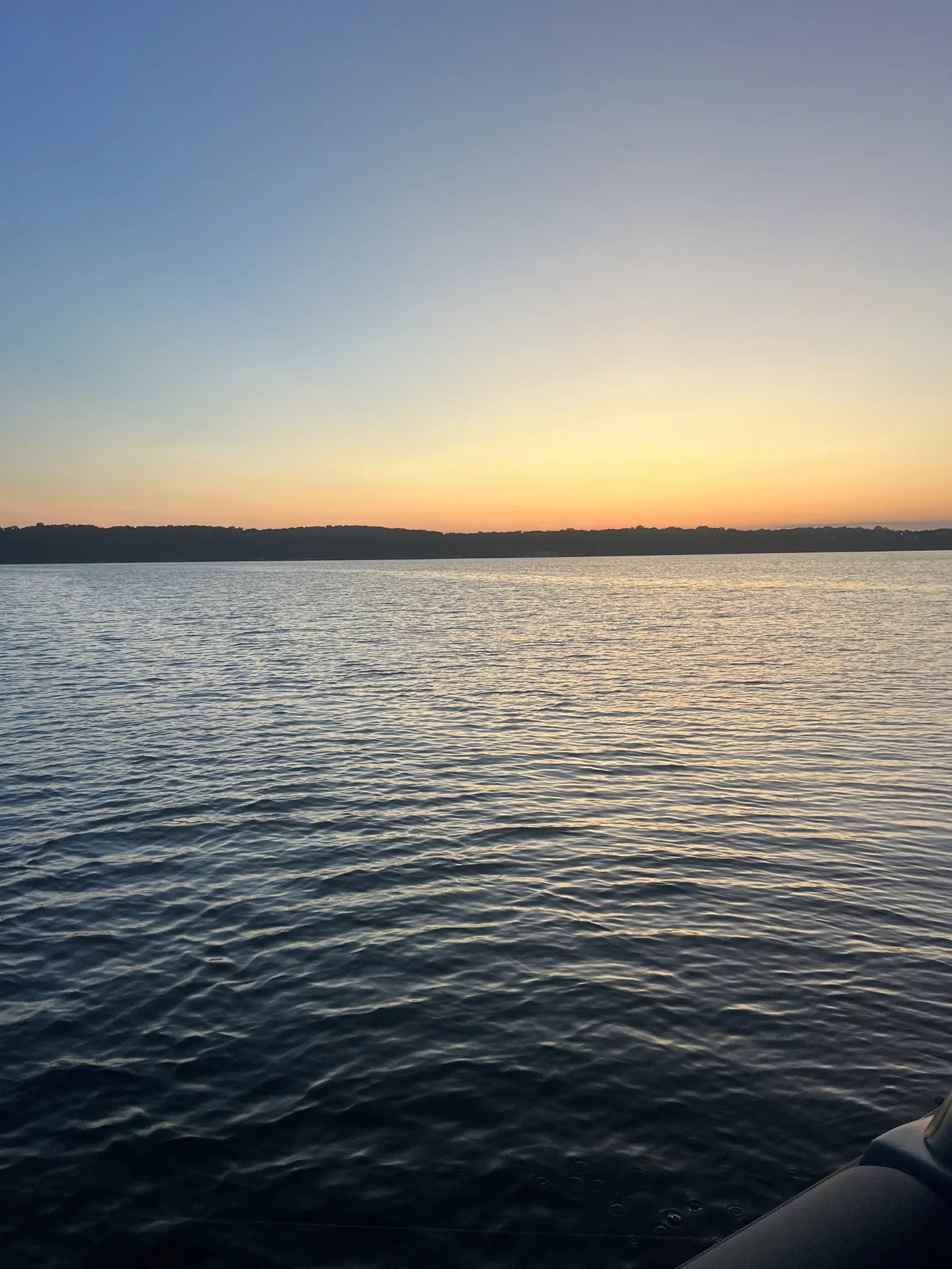
The Snowdale area can be worth the drive. The Wildlife Department puts the Snowdale area north of Highway 20 on the Wolf Creek arm of the lake and says it has a public boat ramp. The Snowdale area is a different part of Lake Hudson from the stretch by our park, and if the fish go quiet, a different arm is a short drive. From us it is 6.9 miles and about 12 minutes, an easy run with a trailer behind you.
The directories we found disagree about what Snowdale offers today, and we could not settle it from an official page. Phone the Grand River Dam Authority at (918) 256-5545, the general number on its recreation rules page, and ask whether the ramp is open on the day you plan to go.
Does it cost anything to launch at a Lake Hudson ramp?
We read the Wildlife Department’s Lake Hudson page, the Grand River Dam Authority’s recreation page and its lake rules. None of them lists a launch fee. The lake rules say that existing public rights of way to the water, and boat ramps sponsored by the Authority, shall remain open as a way of free public passage to and from the water.
That wording covers the Authority’s own ramps. A marina is a business, and it sets its own prices, so ask before you pull in.
How do water levels change what you can launch?
Lake Hudson is a flood control and hydroelectric lake, and the Authority’s lake rules say its elevation will vary as those jobs demand. The lake goes up and down on a schedule that has nothing to do with your weekend. The Wildlife Department says the lake has easy access to the water’s edge at normal levels, so levels away from normal can change how a ramp works.
The Authority posts readings for Lake Hudson on its lake levels page. We could not find a normal pool number there, so the page tells you the lake has moved. It does not say whether your ramp works. On a day when the water looks high or low, drive down and look before you back a trailer in. A look costs two minutes.
How do you choose a ramp for the day you plan to go?
Start with the water you want to fish, then check that the ramp for it is open, then check the lake level and the clock. In that order, because a perfect ramp on the wrong arm of the lake still leaves you with a long run before the first cast, and a long run eats the morning.
If you have never used a ramp, our advice is to look at it before you tow a boat trailer down it. Walk the slope and see where the dock sits. A first visit with the truck and no boat takes ten minutes and tells you what a directory cannot. Guests staying with us have the easiest version of this, because the two nearest ramps are about half a mile from their sites and a look takes one short drive.
What boating rules apply when you launch on Lake Hudson?
The Authority’s Lake Hudson area map lists the basics under the heading Before you launch, and its lake rules add the rest. These apply at the ramp.
- Life jackets must be in good condition, within reach of every person aboard and sized for the person wearing one. Every child 12 or younger must wear an approved life jacket on a vessel under 26 feet long.
- The operator must be 16 or older. A child 12 to 16 may run a boat while carrying proof of a boater safety course, and the operator must carry a state issued ID.
- A no wake zone covers any area posted with buoys and any water within 150 feet of a boat ramp, dock, pier or anchored boat.
- From half an hour after sunset to half an hour before sunrise, the speed limit is 25 miles per hour.
- Skiing is not allowed upstream of the Strang Bridge on Lake Hudson.
- Operating a boat under the influence of alcohol or drugs is unlawful.
Those rules are summaries, and the map itself says additional rules may apply. The Authority’s police can also order any boat that is out of compliance with the rules off the lake until it is fixed, so a missing life jacket can end the day at the ramp. The no wake rule is the one we would tape to the dash. Fifty yards around a ramp holds people backing trailers and kids on the dock, and a wake there throws everyone off balance.
Does a boat from another state need Oklahoma registration?
Not right away. The Authority’s recreation page says a boat registered in another state can be used on its lakes for 60 days without Oklahoma registration. After that, Oklahoma registration is required, and the page says vessels need Oklahoma registration and a license by June 30 each year.
The same page says Authority police inspect boats kept or operated on its lakes, that the inspection is free and that a safety sticker goes on the front port side. If you are moving here, our first month checklist for Mayes County walks through registering a truck and a boat.
What should you know about the dams before you launch?
Kerr Dam is the reason Lake Hudson exists, since the lake formed in 1962 when the Authority built the dam, and the dam can open its floodgates or start its generators while boats are on the water. The Authority’s boat safety page says signs warn of extreme danger in floodgate areas, and red buoys and cabling keep boats out of the dangerous water. Flashing lights come on when floodgates open or generation starts, and sirens sound first.
The area map gives the numbers. No vessel may be within 200 feet of a dam at any time, and none within 500 feet while the dam is generating or releasing floodgates. A variable siren means the floodgates will open, and every boat must be out of the river within 30 minutes. A steady siren means a generator is starting and the water will rise, and boat fishing may continue. Wading and swimming below the dams are not allowed while water is being released, and no snagging of fish is allowed within 1,000 feet of a dam.
Anglers who work the river below the dam in spring should also read our post on paddlefishing near Salina. Learn the siren sounds before you launch.
What about kayaks and paddleboards?
Small craft launch from the same ramps, and the lake rules treat them differently. Anyone on a paddleboard or kayak on the Authority’s waters, and in a canoe too, must wear a life jacket at all times, which is stricter than the rule for adults on a motorboat. Canoes and kayaks under 17 feet long, and all paddleboards, must also stay within 150 feet of the shoreline unless they are in a no wake cove, hollow or creek.
That shoreline rule shapes a paddling day. Powerboats run in the open water, so the rules keep the smallest boats along the edge. Stay near the bank and wear the jacket, and give a ramp a wide berth while boats are loading, since a kayak is hard to see from a trailer.
Who do you call about ramps and rules?
The Grand River Dam Authority’s general line is (918) 256-5545, so call it about whether a ramp is open. Its police non emergency line is (918) 256-0911, listed on the same recreation rules page. In an emergency on the water, call 911.
The Wildlife Department’s Lake Hudson page also lists a phone number for Hudson Dogwood Marina, (918) 434-5181, for more information about the lake. We have not confirmed what that marina offers, so treat it as one more person to ask. A phone call to someone at the lake that day is worth more than a printed list.
Can you camp at a Lake Hudson boat ramp?
The Authority’s lake rules say there shall be no camping on its lands except in a designated camping area. A ramp parking lot and a gravel spot by the water both count as its lands. Plan on sleeping somewhere else.
Boaters who want to launch at first light need a bed close to the water that is not on the Authority’s land.
What does a boating stay at Lake Hudson RV Park look like?
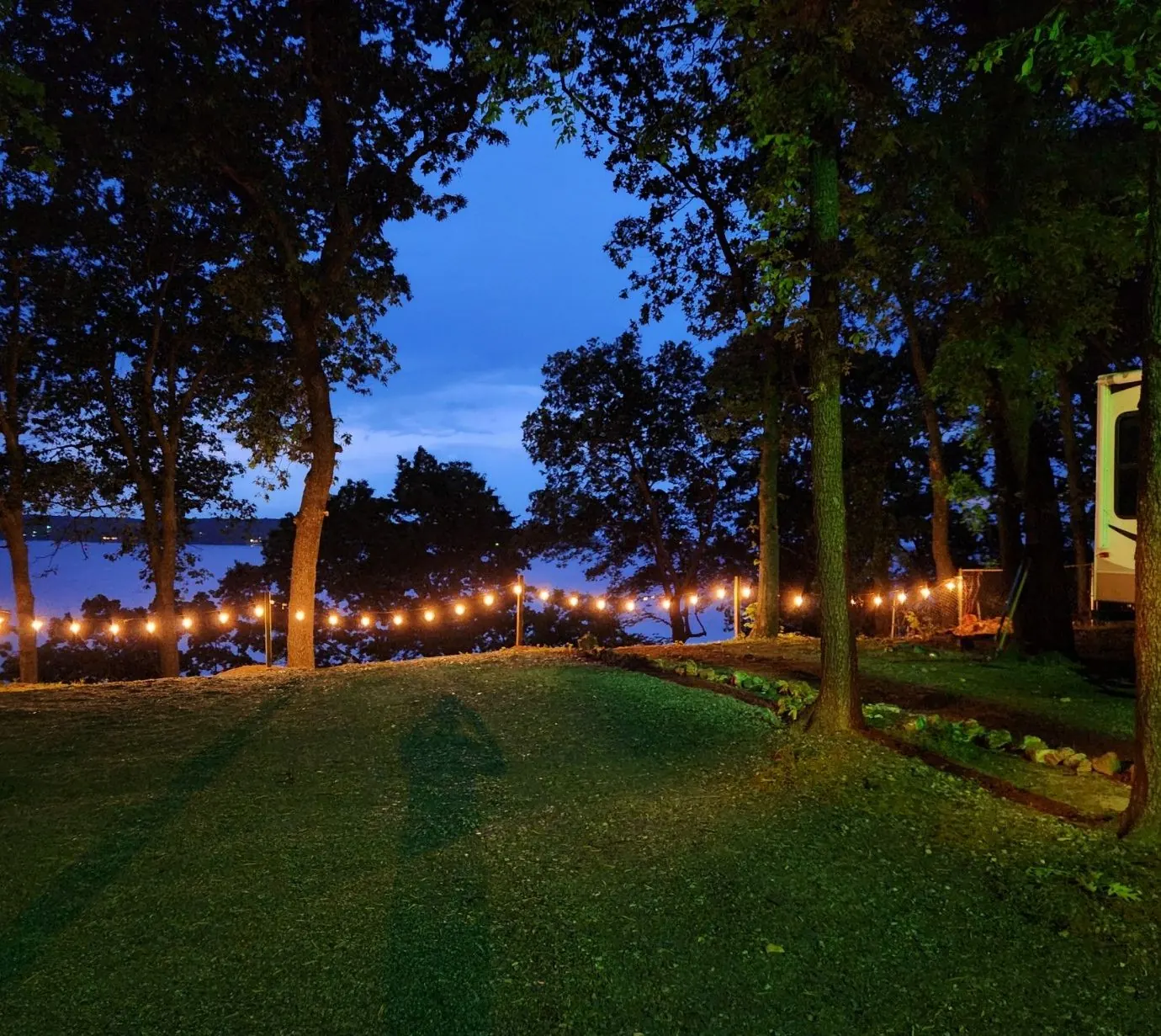
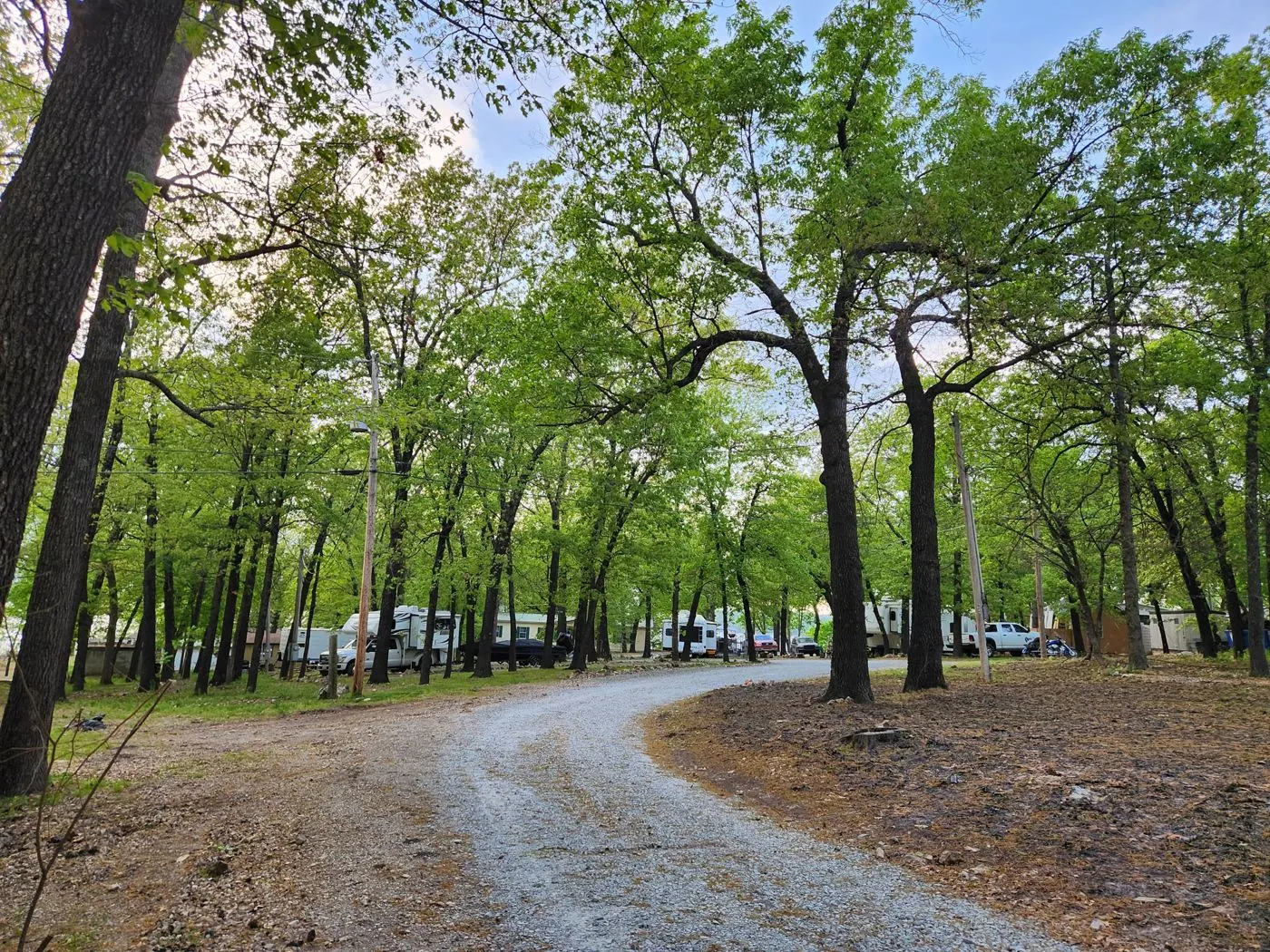
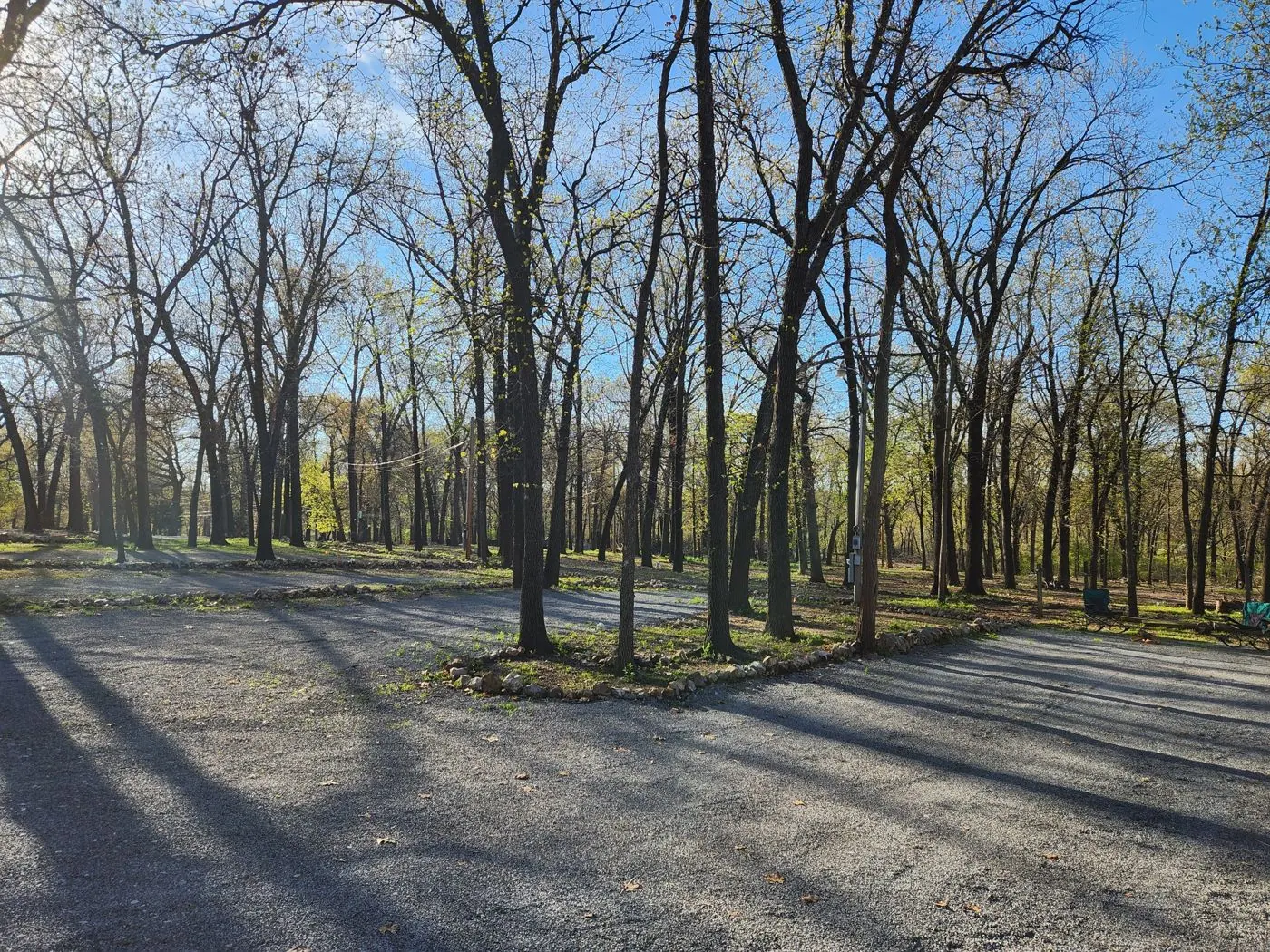
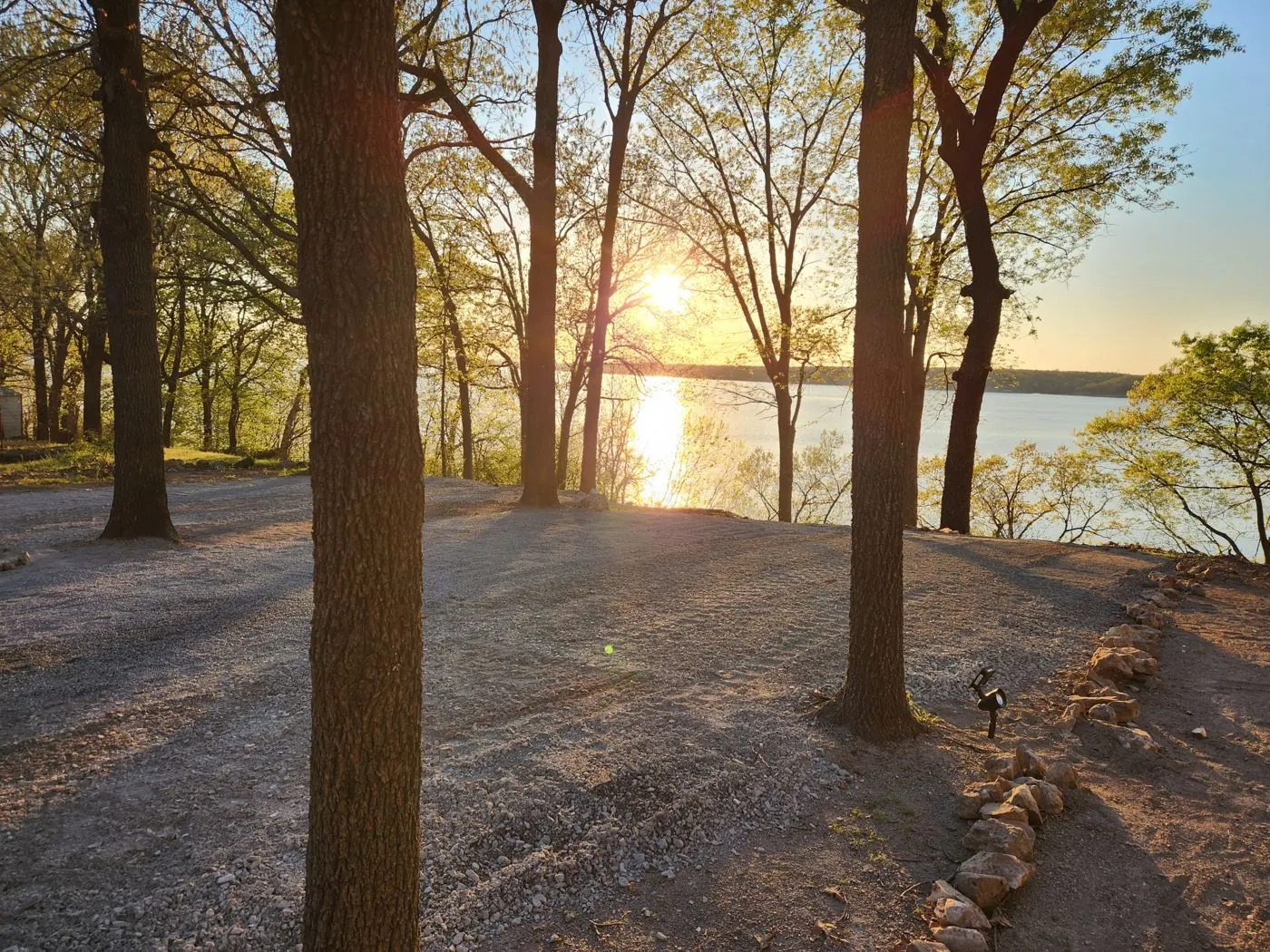
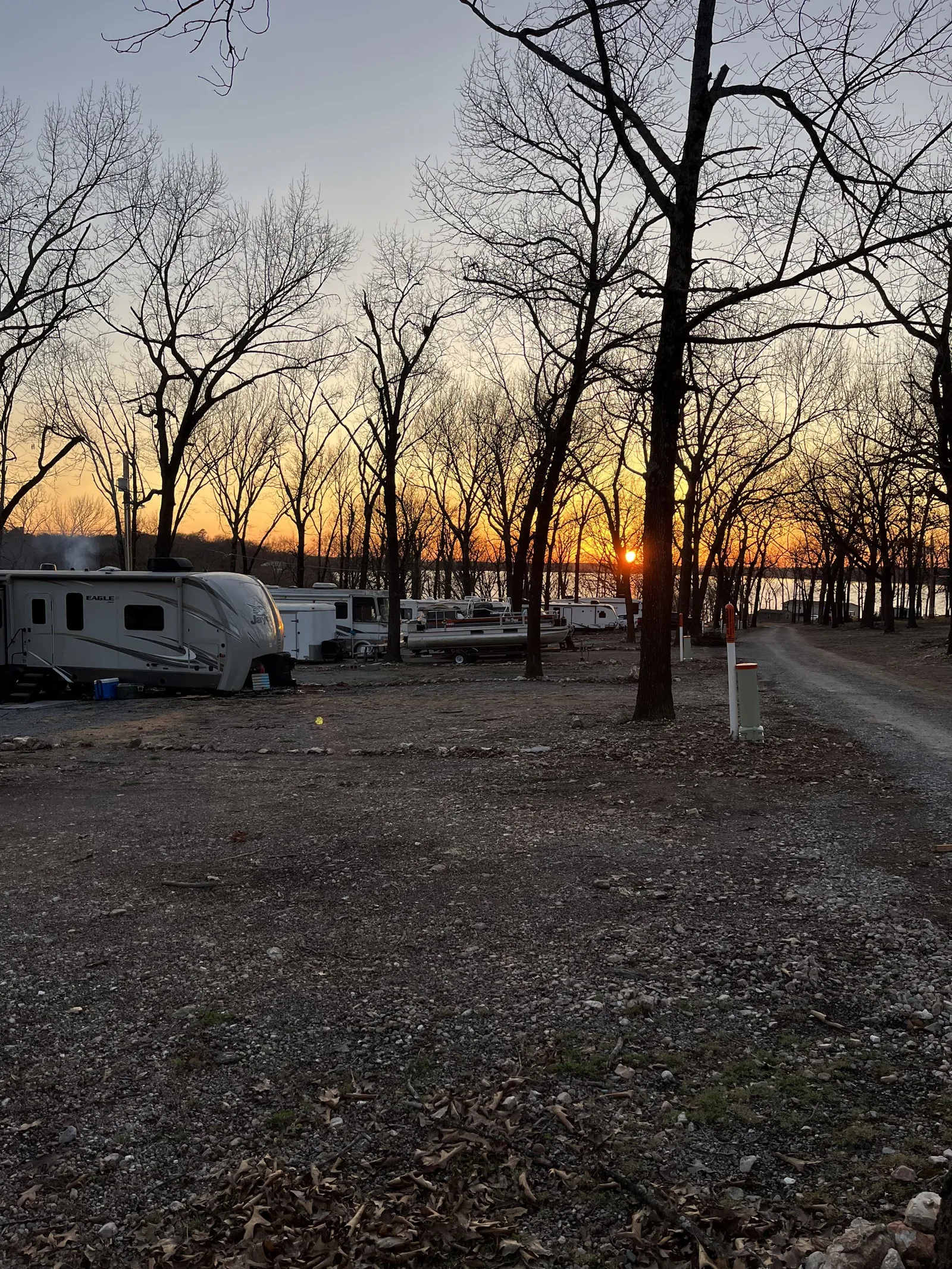
Two public Lake Hudson ramps sit half a mile from the park, one to the north and one to the south, so the boat goes from your site to the water in about a minute and comes home the same way. Our wooded sites have room for the boat right beside the camper, because the park started out as a mobile home community and the lots are big. A typical site is about 35 feet wide and 120 feet deep, roughly 4,200 square feet, enough for a truck and a camper with a boat beside them. A 32 foot RV with a pickup and a boat beside it fits on one of our sites. Our 10 budget sites are smaller and have no room for a boat, so tell us about the boat when you call and we will point you to a site that fits it.
Wooded sites, 50 of them, are a flat $350 a month plus electric, and our 7 lake view sites are $450. Budget sites start at $300. Electric runs about $100 a month for most guests, higher with heavy summer air conditioning. Nightly stays are $47 if you want a weekend on the water first, and the $100 deposit comes once we approve your stay. Every site has full hookups with 30 and 50 amp, your RV should be 10 years old or newer, and we look at older rigs case by case from photos.
There is a storm shelter on site and laundry for the wet towels. We have 4.7 stars from 57 Google reviews, and one guest put the location this way.
Great spot to stay! The park was clean, quiet, and well maintained. Easy access and a relaxing atmosphere by the lake.
 Tre N.Google review
If you are weighing a monthly site against what it costs to live near Pryor, our post on monthly RV site costs in Pryor, OK lays the numbers side by side. Our Lake Hudson fishing page shows the routes to the ramps, the marina and the dam, and monthly RV sites lists each site type.
Tell us about your boat and your rig, and we will tell you which sites have room for both.
Launch day, step by step
Most of this happens before you leave the site.
- Call the Grand River Dam Authority at (918) 256-5545 and ask whether the ramp you picked is open today.
- Open the Authority’s lake levels page and check that the lake has not moved much since your last trip.
- Look at the registration sticker and the safety inspection sticker on the boat, and put a state issued ID in your pocket.
- Count the life jackets and make sure each one fits its wearer, then put the children’s jackets on before you get near the water.
- Check the trailer lights and the tire pressure, then put the drain plug in before you back down.
- Do the loading in the parking area, so the ramp stays clear for the next boat.
- Back down and launch, then move the tow vehicle out of the way and idle the boat clear of the ramp, since the 150 foot no wake zone applies.
- Check the clock against sunset. Half an hour after sunset the limit drops to 25 miles per hour.
- If a variable siren sounds near a dam, get out of the river within 30 minutes. A steady siren means the water will rise, so watch it.
- When you are done, rinse the trailer and park the boat beside the camper.
What is there to catch once the boat is in?
The Wildlife Department’s Lake Hudson page lists largemouth bass, black and white crappie, paddlefish, white bass, striped hybrid bass and three kinds of catfish as the fish of interest, and says hybrid striped bass are regularly stocked. The same page lists a crappie limit of 15 combined a day with a 10 inch minimum. A fishing license is separate from anything at the ramp, and the Authority’s recreation page says you can buy one online from the Wildlife Department.
The fishing guide we linked near the top goes through the seasons and the methods. This post stops at the ramp.
Easy mistakes at Lake Hudson ramps
A map app can send you to a ramp that has changed, since a pin on a screen knows nothing about the water level. A call to the Authority before you go fixes that.
Daylight habits cause the next problem. The 25 mph night limit starts half an hour after sunset, and it arrives sooner than you expect when the fish are biting, so plan to be at the ramp or at idle before the light is gone.
A boater used to one ramp can also forget that the 150 foot no wake zone covers docks and anchored boats, so a few boats at anchor in a cove count as much as a dock does. Idle until you are well clear. And a boat from another state is fine for 60 days. A boat that stays a month gets there quickly, so put a reminder on your phone the day you arrive.
Sources
- Oklahoma Department of Wildlife Conservation, Lake Hudson (access points, crappie limit, lake notes), checked November 10, 2026
- Grand River Dam Authority, Lake Hudson Area Map (dam rules, sirens, Before you launch), checked November 10, 2026
- Grand River Dam Authority, Lake Rules, Title 300 Chapter 35 (effective August 11, 2024), checked November 10, 2026
- Grand River Dam Authority, Recreation Rules and Maps (registration, inspection, contact number), checked November 10, 2026
- Grand River Dam Authority, Boat Safety (floodgate warnings), checked November 10, 2026
- Grand River Dam Authority, Lake Levels, checked November 10, 2026